

Deadlift grip, and what to do when it fails first
Double overhand, hook, mixed and straps, what each one costs and buys, the safety note on the mixed grip, chalk, and when straps are fine.
By Lift CalculatorUpdated 27 October 20264 min read
When your grip gives out before your back and legs do, change how you hold the bar. There are four ways to do it: double overhand, hook, mixed and straps. Each one trades comfort, safety and how much it lets you hold. In our view most lifters can train with double overhand and straps, and only need hook or mixed if they compete.
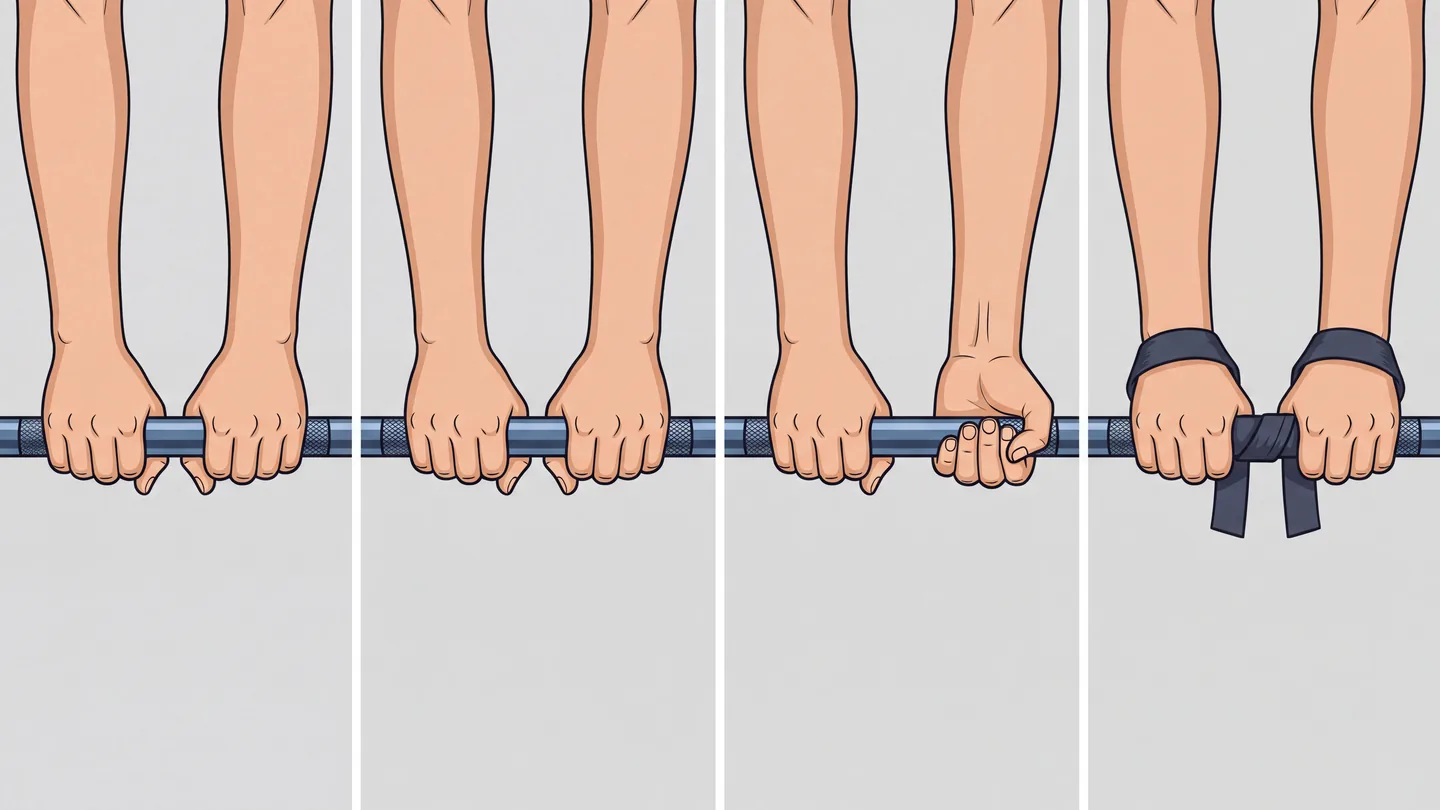
Why grip fails first
The deadlift is the heaviest lift most people do, and the whole load hangs from the fingers. The legs and back can lift more than the hands can hold, so on a heavy set the bar starts to roll out of the hands before the rest of the body is done.
Double overhand
Both palms face you. It is the grip everyone starts with, it loads both arms the same way, and it is the grip the 2021 study of biceps ruptures (opens in a new tab) suggests may lower the risk of that injury. Its limit is strength. The bar rolls toward the fingertips, and on heavy sets it is the first grip to give out.
Hook
Both palms face you, with the thumb wrapped around the bar first and the first two fingers holding the thumb down. It is standard in Olympic weightlifting (opens in a new tab), where it keeps the grip through the fastest part of the pull. It holds better than a plain double overhand and keeps the shoulders level.
The cost is the thumb. The grip presses hard on it (opens in a new tab), and it takes up to about two weeks before that stops hurting. Some lifters tape the thumb while they get used to it.
Mixed
One palm faces you and the other faces away. The bar cannot roll out, because what rolls it out of one hand rolls it into the other, and it is the traditional grip for heavy deadlifts (opens in a new tab).
It carries one specific risk. A 2021 study of 35 distal biceps tendon ruptures filmed on video (opens in a new tab) found most happened during the deadlift. Every rupture in a mixed grip was in the arm turned palm up. The authors suggest that holding the bar with both palms facing you may prevent or lower that risk. The study is small and describes what the videos show, so it cannot say how often it happens. If you use a mixed grip, keep the palm-up arm straight and do not pull with it.
Straps
A strap loops round the wrist and wraps the bar, so the bar hangs from the wrist as well as the fingers. In a 2021 study of 16 men (opens in a new tab), straps kept grip strength from fading across sets, let the lifters move the same weight faster, and made the effort feel easier. They are not allowed in powerlifting competition under the IPF's rules (opens in a new tab), which allow the other three grips.
Chalk and grip training
Chalk dries the hands. The evidence on whether it helps comes from climbing, and it points both ways. One study found chalk raised friction on rock by 18.7 to 21.6 percent (opens in a new tab). An earlier one found it lowered friction (opens in a new tab). Neither tested a barbell. In our view it is worth trying on heavy sets, since it costs little.
Grip gets stronger by holding heavy things. Hold the last rep of a heavy set at the top for a few seconds, or finish a session with heavy holds in the rack. Do your lighter sets without straps, so the hands do some of the work every week.
When straps are fine
If you do not compete, straps are fine for any set where grip, not the deadlift, would end it. That is usually the heaviest sets and the high-rep sets. Use your own grip on the warm-ups and the lighter work, so your grip keeps up with the rest of you. If you do compete, train the grip you will use on the day and keep straps for back-off sets and other pulls.
Common questions
Is the mixed grip dangerous? The risk is to the biceps of the arm that is turned palm up. A 2021 study of 35 distal biceps ruptures filmed on video found most happened in the deadlift, and every one in a mixed grip was in the palm-up arm. The authors suggest both palms facing you may lower the risk.
Does the hook grip hurt? At first. It presses hard on the thumb, and it takes up to about two weeks to get used to.
Are straps cheating? Not in training. A 2021 study found straps kept grip strength up across sets and let lifters move the same weight faster. They are not allowed in powerlifting competition, so practise without them if you compete.
Does chalk help? Probably, though the evidence comes from climbing and is mixed. One study found it raised friction by about a fifth. An earlier one found it lowered friction.
Sources
- The role of deadlifts in distal biceps brachii tendon ruptures, an alternative mechanism described with YouTube videos (opens in a new tab), Orthopaedic Journal of Sports Medicine, 2021, on PubMed Central
- Ergogenic effects of lifting straps on movement velocity, grip strength, perceived exertion and grip security during the deadlift exercise (opens in a new tab), Physiology and Behavior, 2021 (Abertay University repository)
- Hook grip (opens in a new tab), Wikipedia
- The effect of chalk on the finger-hold friction coefficient in rock climbing (opens in a new tab), Sports Biomechanics, 2012
- Use of chalk in rock climbing: sine qua non or myth? (opens in a new tab), Journal of Sports Sciences, 2001 (University of Birmingham)
- IPF Technical Rulebook, effective 1 March 2026 (opens in a new tab), International Powerlifting Federation
Related
The tools on this site put these numbers on the bar for your own lifts.
Check your deadlift in the calculator